


.png)


When Every Child Can Succeed in Art
How process-led art projects allow every child to succeed, experiment, and create something entirely their own.

As I reflect on my time as a teacher, particularly the art projects I delivered, one stands out. It remains one of my favourites and offers a perfect example of the power of a process-led approach.
The aim of the project was to explore expression through the human figure and translate that exploration into a three-dimensional model using modelling wire and mod-roc.
The project began with observation. Through life drawing and studying expressive illustrations by Quentin Blake, the children explored how posture, gesture, and movement can communicate feeling, action, and character. Drawing became less about accuracy and more about noticing, interpreting, and experimenting with ideas.
“Drawing became less about accuracy and more about noticing.”
From there, the children developed their own poses using quick sketches before moving into three dimensions with modelling wire. This stage required patience, problem-solving, and a great deal of trial and error.
The children persisted with tired hands and fingers as they got used to manipulating the modelling wire. Their ideas were adjusted and refined until they were happy with the skeleton of their model. The sculptures were then built up with newspaper, coated in Modroc, and later finished with layers of tissue paper and PVA glue.
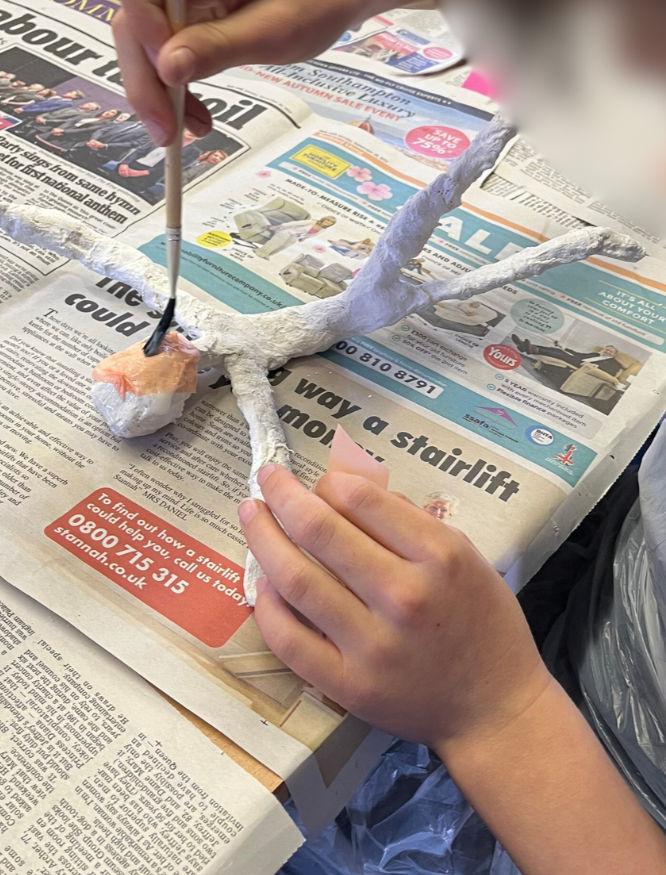
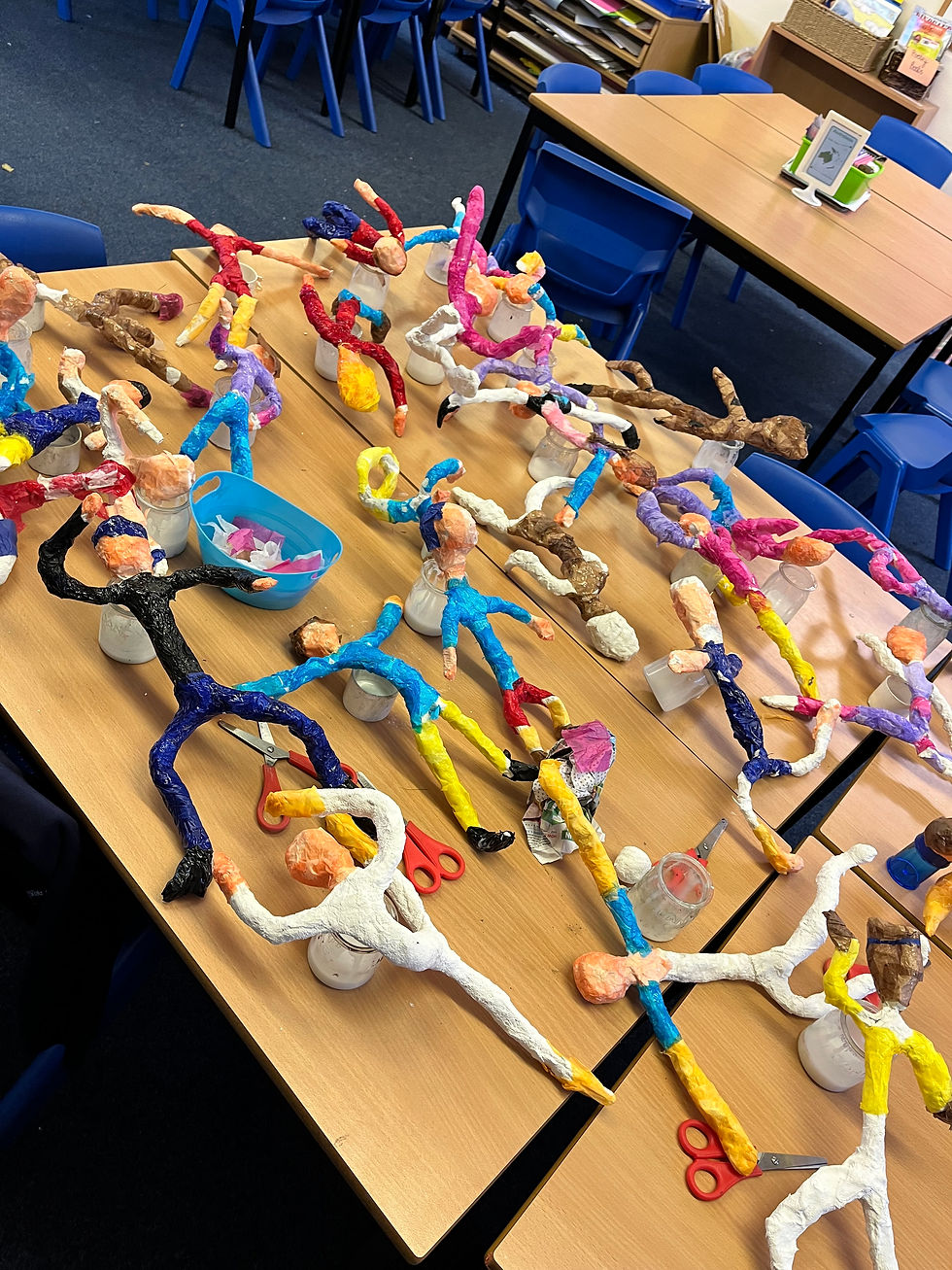
The results were extraordinary.
Every child followed the same process and learned the same skills - yet no two sculptures were the same.
“Shared process, individual outcomes.”
The sculptures reflected the interests of each child - some joyful and energetic, others thoughtful, dramatic, playful or calm.
What made this project so memorable was not simply the outcomes, but the experience of the children throughout.
Every child could access the work.
Every child could access the work. There was no single “correct” pose, no example to copy, and no pressure to replicate a teacher-defined version of success.
Children worked at different paces, explored different ideas, and made their own creative decisions.
“Everyone could succeed.”
It's why I love teaching art the way I do.
Everyone can engage, everyone can succeed and everyone can feel genuine pride in their own work - because it is completely their own.
This is the power of a process-led approach.
Structure and guidance remained throughout the project, but space was protected.
Space to observe.
Space to experiment.
Space to make decisions.
Space to make mistakes.
Space to rethink.
“Space was protected.”
For me, as the teacher, it was one of those rare projects where you could really see the thinking happening. The focus, the determination when things became tricky, and the pride on their faces when their models were finished made it an incredibly rewarding experience.
When art projects become purely step-by-step exercises, children often become focused on getting things “right”. The emphasis shifts towards replication rather than exploration.
While these activities can produce neat outcomes, they do not always allow children to wrestle with ideas, test possibilities, or develop confidence in their own creative thinking.
In this project, the children had agency.
They learned that uncertainty is part of making. That trying and failing is not fatal. That creative decisions are something you work through rather than receive.
“Trying and failing was not fatal.”
And perhaps most importantly, they learned that they were capable of creating something that was entirely their own.
Support Your Child’s Creativity
If you have a young artist who loves drawing, making, exploring, or simply working creatively, the upcoming Sketchbook Studio afterschool sessions offer a calm, process-led space designed to nurture curiosity, confidence, and individual creative voice.


Comments